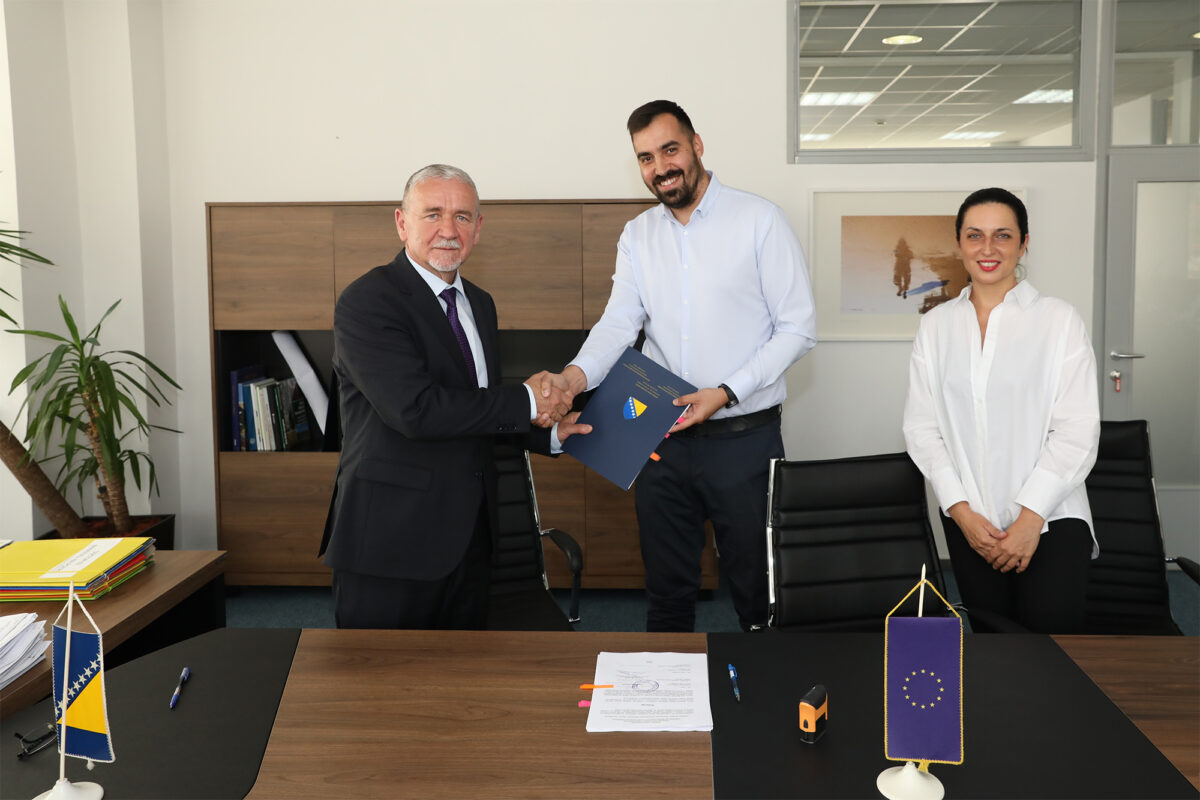
Contracts signed for the Reconstruction of Five Public Buildings in the Herzegovina-Neretva and Sarajevo Canton

Within the AF BEEP project (Additional Financing for the Energy Efficiency Project for Bosnia and Herzegovina), four more facilities in Herzegovina-Neretva Canton and one in Sarajevo Canton will be reconstructed in the coming period to better its energy efficiency.

Four public buildings in Mostar and one in Sarajevo will become energy efficient


Within the AF BEEP project (Additional Financing for the Energy Efficiency Project for Bosnia and Herzegovina), implemented by the Federal Ministry of Spatial Planning, with the World Bank loan funds, four more facilities in Herzegovina-Neretva Canton and one in Sarajevo Canton will be reconstructed in the coming period to better its energy efficiency. On that occasion, contracts were signed today between Josip Martić, the Federal Minister of Spatial Planning of BiH, and representatives of selected contractors.


Four public buildings in Mostar, where energy efficiency measures will be implemented, are the Clinic for Physical Medicine and Rehabilitation, the Clinic for Infectious Diseases, the Clinic for Skin and Venereal Diseases and the Center for Clinical Pharmacology, and the Clinic for Internal Medicine with the Dialysis Center in Mostar, as well as the building of the Police Academy in Sarajevo. More than 2 million BAM will be invested in the renovation of these facilities.


“Project results that have been achieved from the beginning of its implementation in 2016 until today clearly indicate how much energy efficiency measures contribute, not only to the quality of public institutions in which they are implemented, but also to savings of cantonal funds in which they are implemented. As part of the project, 13 public buildings in the Herzegovina-Neretva Canton have been renovated so far, with investments in the amount of almost 9 million KM. In addition to the fact that these measures significantly contribute to the protection of the environment, living conditions and use of these facilities have been improved for their users,” said Josip Martić, Federal Minister of Physical Planning of BiH.


Work such as thermal insulation of walls and roofs, replacement of carpentry and facade, replacement of lighting fixtures with more energy efficient ones and replacement of energy sources will, among other things, be done as part of the implementation of energy efficiency measures at these facilities.


In the period from 2016 to 2020, the implementation of energy efficiency measures at 55 objects in the Federation of BiH was successfully completed within the Project, with over 25 million BAM invested. By 2020, some of the results achieved are: estimated 17,716,570 kWh of savings per year, improved comfort for over 457,009 users, 1,325 green jobs created, CO2 emissions reduced by 4,564 tons during the year.

How to reduce your carbon footprint?

If you are wondering what a carbon footprint is and why it is so important, keep reading. We have researched the best ways to reduce carbon emissions. Every one of us can contribute and reduce our carbon footprint.


If you are wondering what a carbon footprint is and why it is so important, keep reading. We have researched the best ways to reduce carbon emissions. Every one of us can contribute and reduce our carbon footprint. This will save you money and time, help you avoid traffic, reduce pollution, improve air quality and help you enjoy a healthier and more active lifestyle. To begin with, let’s learn that the carbon footprint stands for the total amount of greenhouse gas emissions that result from the production, use, and end of life of a product or service. Usually, most of an individual’s carbon footprint comes from transportation, housing and food.


You can reduce your carbon footprint and help the environment in many different ways. Whether at home, at work, at school or while traveling, small changes make a big difference. AF BEEP project experts (Additional Funding for the Bosnia Energy Efficiency Project) advise you on the most effective ways to do this.


What type of transportation do you use?


Let’s start with transportation. Let’s be realistic; you’ll probably still need to use a car, but when you do, here are some tips on how to make your trip more climate-friendly.


Use gasoline and brakes slowly – efficient driving can help reduce emissions. Service your car regularly to make it more efficient. Check your tires because if the tires are inflated properly, emissions can be reduced. Use cruise control on longer journeys – in most cases, this can help save fuel. Use alternative transportation (bus, train or bike) to get to work at least one day a week. Enjoy the opportunity to catch up on reading instead of trying your patience in traffic!


What do you eat and drink?


Stop buying water in plastic containers. Get a reusable water bottle and keep it with you at all times. You will save money and the environment! Eat more fruits and vegetables and less meat. Meat and dairy products are responsible for 14.5 percent of global man-made greenhouse gas emissions. Each day you give up meat and dairy products, you reduce your carbon footprint by 8 kilograms – that’s 2,920 kilograms a year. You can start by joining the so-called “Meatless Mondays.”


Choose organic and local foods that are in season, and reduce food loss by planning meals ahead of time, freezing excess, and reusing leftovers.


What are you wearing?


Don’t buy fast fashion. Trendy, cheap items that go out of style are quickly dumped in landfills, where they produce methane as they decompose. Instead, buy quality clothes that will last. Better yet, buy vintage or recycled clothes.


Wash your clothes in cold water. Enzymes in cold water detergent are designed for better cleaning in cold water. Washing your laundry twice a week in cold water instead of warm water can save up to 500 kilograms of carbon dioxide each year.


Where do you live?


Give your home an energy audit. This will show how you consume energy and help identify ways to be energy efficient.


Replace ordinary bulbs with LED ones. Although LED bulbs cost more, they consume a quarter of the energy and last up to 25 times longer. Turn off the lights when you leave the room and turn off your electronic devices when not in use. Every little action counts!


By installing a low-flow shower, you can reduce hot water consumption and save 350 kilograms of CO2. A quicker shower also helps.


Simple actions really add up when everyone joins! The decision to take action means you want to take care of what you call home, making your city greener and healthier to live in. If you do your part, you have already done enough!

Three ways you can contribute to reducing energy consumption in cities

There is a tendency in the world to expand cities, which makes the population density increase. The situation is the same in our country, larger city centers are expanding more and more, people are immigrating from smaller places. All this results in an increase in energy consumption and emissions.


There is a tendency in the world to expand cities, which makes the population density increase. The situation is the same in our country, larger city centers are expanding more and more, people are immigrating from smaller places. All this results in an increase in energy consumption and emissions.


Investing in more efficient and smarter energy use in cities helps reduce carbon dioxide emissions. That’s why we are bringing you three ways you can contribute to reducing energy consumption in your local communities.


Sustainable and smarter building construction


It will take a long time for the improvement of energy efficiency of buildings to be effectively implemented in BiH, but it is necessary for all cities that want to achieve sustainable growth and development. Buildings account for approximately one-third greenhouse gas emissions, and in large cities perhaps half. Reducing the energy used to heat, cool and illuminate buildings must be a key component of the broader climate goals that cities must undertake. The method of construction is also extremely important, so for a reason the so-called green or eco construction increasingly popular. In our country, it is still not represented for economic reasons and the price of materials.


One solution to this problem could be incentives and special credit lines for investors, if they opt for this method of construction. A great opportunity for those who are just starting a business or already have companies that deal with construction materials is the introduction of this range. This will make it easier to find materials that will save energy significantly and reduce or eliminate negative environmental effects, through the use of less water, energy or natural resources and the creation of your own energy. This will improve the quality of life in buildings and reduce maintenance costs.


How to reduce energy consumption by organized transport?


The problem that cities face daily is transportation and huge energy consumption and pollution emissions using private cars. Probably one of the more expensive and complex solutions to reduce energy consumption in cities is to offer and maintain various public transportation options. That should deter people from driving. Bus, subway or train lines make it easier to drive better and faster. They simultaneously reduce reliance on cars and, in fact, reliance on gasoline. Strengthening this infrastructure makes it easier to transport residents with as little energy as possible.


When cities invest in sheltered bike lanes on the roads, people will feel safer riding bikes instead of cars. Cities can also offer bicycle sharing services. Together, these changes reduce car density on the road and energy consumption. In our country, the first major step forward was made with the construction of bicycle paths in the capital of BiH and introducing the Next Bike system of public bicycles, which currently exists in Sarajevo, Zenica and Banja Luka.


It is also very important to encourage citizens to be more energy aware through the use of electric or hybrid cars. In BiH, for now, the steps in motivating drivers to buy such cars are minimal, and currently there are less than a hundred charging stations for electric and hybrid vehicles. Using electric cars contributes to decarbonization, ie reduction of emissions of harmful gases and particles.


LED technology and solar panels as a great way to save energy


LED street lighting has a major impact on reducing CO2 emissions and electricity consumption. Using LED lights could be up to 60 percent more efficient than a traditional street lighting system. The first investment in changing lamps may be an initial hurdle for municipalities, but the solution may be through state subsidies, which would make it easier for local authorities to transform their street lighting system into a much more efficient one.


By installing solar panels, which absorb sunlight, on buildings, the city could take advantage of free energy as electricity generation or heating during daylight hours. This would make the best use of the huge and existing area. It will also reduce the amount of fossil fuel people use.


We know it is difficult to implement all these solutions at once, but if we take small steps towards the set goals and give our contribution to the initiative, we are sure that the results will be visible soon.

Easy ways to save energy while working from home

Additional Funding for the Bosnia Energy Efficiency Project (AF BEEP) experts bring you as many as 7 tips on how to make your home office more energy efficient in a very simple way.


Working from home has become the new normal, and many have replaced their job with their home offices. More time spent at home means more energy consumption. However, that does not have to be the case, and here is why.

Additional Funding for the Bosnia Energy Efficiency Project (AF BEEP) experts bring you as many as 7 tips on how to make your home office more energy efficient in a very simple way.

  • When the phone or any other electrical device is done charging, unplug it. Many chargers use power even when not connected to a device.
  • Turn off the lights when leaving the room. If the room you work in has enough sunlight, open the blinds and turn off all lights while you work.
  • If you do not already have air purifiers installed, it is high time you got them. Remember to change the filters regularly because clean filters consume less energy and reduce the burden on your system.
  • When your heating or cooling system is working, close the windows. This way, cooling/heating will be much more efficient, and you will not waste electricity unnecessarily.
  • If you have older light bulbs, switch to LED lights that consume much less energy.
  • By using the sleep mode option on your computer or any additional devices, power management can save up to 100 KM per year. If you do not plan on using the computer for more than two hours, AF BEEP experts recommend that you turn it off.
  • Purchase ENERGY STAR® certified office supplies, such as computers, monitors and printers. They consume less energy to perform regular tasks, and when not in use, they automatically enter low-power mode.

Try to implement as many of these simple, low-cost, and free tips in your routine in order to reduce electricity usage at home as much as possible. An additional tip, which could be useful for you, is that if you have a smart meter at home, sign up for one of the available free applications through which you can track how and when you use energy so that you can make any needed adjustments.


Many global companies have already permanently switched to working from home, and some of them offer both options to their employees. If you are one of the supporters of the home office, these tips will be of great use to you.

World Environment Day – How we can contribute to protecting our Planet

Today, we remind you to celebrate World Environment Day with us.


We often want to change the world, the environment we live in or our day, month, year. When we look at the world around us, we see shortcomings in the environment and society that we would all be happy to change for the better. The progress we make is usually far from the goals we envisioned. Still, it’s important to get moving and give our contribution to make us feel better. If we work hard every day, we will be much closer to the goals we have set. Today, we remind you to celebrate World Environment Day with us.


This day is celebrated every year on June 5 in more than 140 countries around the world, and its goal is to point out the importance of all of us in the chain of protection of the environment in which we live in. No, don’t be skeptical and wonder how you can help. You can, very easily, it’s just important to start.


In urban areas, air pollution is the biggest environmental risk to health and the environment. According to the World Health Organization, nine out of ten people breathe polluted air. How can you contribute to reducing air pollution?


Let’s start with the winter that is now behind us. Did you know that the way we heat contributes to air pollution? Certain heating methods are more harmful than others, so e.g., gas heating, natural wood or pellets are a much better option than coal and other energy sources that have a high emission of harmful substances. If you install a pellet stove or some other form of heating in your apartment or house that will use better quality energy, you will do yourself a favor. You will be ready for the next heating season, and you will save your health and the health of your family.


Let’s continue with small steps. The days are getting sunnier and warmer, so make the decision to go to work by bike today. Make it a practice a few days a week, and invite your colleagues and friends to join you. Why not? Just imagine how much pollution and motor vehicle emissions you will reduce. You can survive without a car, and you will do good for yourself, your health, but also the ozone. If you still can’t imagine walking or cycling, public transportation is a great alternative. Reduce the use of private cars and use less polluting public transport. On days when it is necessary to drive a car, a start-stop system is a great option. While waiting for the green light at the traffic light, turn off the engine. Little things make a difference.


Summer is also a time of new decisions. Use them to freshen up and renovate your home. Buy new furniture, but let it be made of natural materials. This way, you contribute to the protection of the environment in which you live. Warmer days are ideal for renovations and changes in your home. In addition to your style and sense of aesthetics, or the design you want, pay attention to environmentally friendly and non-toxic colors and materials.


Another little tip for your new home – save electricity and be responsible. When you are not using household appliances or lights, simply turn them off. Why spend money and energy that goes to waste? Rituals that will contribute to the efficient use of energy and will not make it difficult for you. On the contrary, you will feel useful.


We can’t influence a lot of things, like global warming, but certainly by applying some of these, maybe not so important at first, decisions, we can make the environment more beautiful and be at least a little more conscientious towards ourselves and others. Because we can, because we want to.

Internal Medicine Clinic with Dialysis Centre

INTERNAL MEDICINE CLINIC WITH DIALYSIS CENTRE, MOSTAR

Zrinskog Frankopana 34, Bijeli Brijeg, Mostar

Heated area: 3,845.09 m2


Energy efficiency measures:

  • Thermal insulation of facade walls;
  • Thermal insulation of flat and pitched roofs;
  • Replacement of existing joinery and/or metalwork;
  • Installation of dynamic thermostatic valves;
  • Partial replacement of lighting fixtures;
  • Installation of equipment for measuring energy consumption;
  • Installation of temperature and humidity monitoring equipment;

Total investments (BAM with VAT): 801,299.06
Estimated savings on energy costs after the realization of the sub-project, on an annual basis – calculated (BAM): 91,983.21
Total energy savings (thermal and electrical): 543,789 kWh/year
CO2 emissions: 191 tCO2 /year
Start of works: 16/08/2021
Works completed/Date of technical acceptance: 23/03/2023

Clinic for Physical Medicine and Rehabilitation, Clinic for Infectious Diseases, Clinic for Skin and Venereal Diseases and Center for Clinical Pharmacology, SKBM Directorate, MOSTAR – Facility 3

CLINIC FOR PHYSICAL MEDICINE AND REHABILITATION, CLINIC FOR SKIN AND VENEREAL DISEASES AND CENTER FOR CLINICAL PHARMACOLOGY, SKBM DIRECTORATE, MOSTAR – FACILITY 3

Kralja Tvrtka b.b., Mostar

Heated Area: 3,597.47 m2


Energy efficiency measures:

  • Thermal insulation of facade walls;
  • Thermal insulation of the ceiling towards the unheated attic;
  • Replacement of existing joinery and/or metalwork;
  • Replacement of boiler and energy source;
  • Improvement of the central heating system;
  • Partial replacement of lighting fixtures;
  • Installation of equipment for measuring energy consumption;
  • Installation of temperature and humidity monitoring equipment;
  • Replacement of asbestos cement roof panels with the new cover made of a steel sheet;

Total investments (BAM with VAT): 691,342.26
Estimated savings on energy costs after the realization of the sub-project, on an annual basis – calculated (BAM): 145,324.36
Total energy savings (thermal and electrical): 571,464 kWh/year
CO2 emissions: 125 tCO2 /year
Start of works: 16/08/2021
Works completed/Date of technical acceptance: 24/06/2022

Clinic for Physical Medicine and Rehabilitation, Clinic for Infectious Diseases, Clinic for Skin and Venereal Diseases and Center for Clinical Pharmacology, SKBM Directorate, MOSTAR – Facility 2

CLINIC FOR PHYSICAL MEDICINE AND REHABILITATION, CLINIC FOR SKIN AND VENEREAL DISEASES AND CENTER FOR CLINICAL PHARMACOLOGY, SKBM DIRECTORATE, MOSTAR – FACILITY 2

Kralja Tvrtka b.b., Mostar

Heated area: 835,24 m2


Energy efficiency measures:

  • Thermal insulation of facade walls;
  • Thermal insulation of of the flat roof;
  • Replacement of existing joinery and/or metalwork;
  • Improvement of the central heating system;
  • Partial replacement of lighting fixtures;
  • Installation of equipment for measuring energy consumption;
  • Installation of temperature and humidity monitoring equipment;

Total investments (BAM with VAT): 190,350.70
Estimated savings on energy costs after the realization of the sub-project, on an annual basis – calculated (BAM): 22,017.16
Total energy savings (thermal and electrical): 112,185 kWh/year
CO2 emissions: 34 tCO2 /year
Start of works: 16/08/2021
Works completed/Date of technical acceptance: 24/06/2022

Clinic for Physical Medicine and Rehabilitation, Clinic for Infectious Diseases, Clinic for Skin and Venereal Diseases and Center for Clinical Pharmacology, SKBM Directorate, MOSTAR – Facility 1

CLINIC FOR PHYSICAL MEDICINE AND REHABILITATION, CLINIC FOR SKIN AND VENEREAL DISEASES AND CENTER FOR CLINICAL PHARMACOLOGY, SKBM DIRECTORATE, MOSTAR – FACILITY 1

Kralja Tvrtka b.b., Mostar

Heated area: 582,42 m2


Energy efficiency measures:

  • Thermal insulation of facade walls;
  • Thermal insulation of the flat roof;
  • Replacement of existing joinery and/or metalwork;
  • Improvement of the central heating system;
  • Partial replacement of lighting fixtures;
  • Installation of equipment for measuring energy consumption;
  • Installation of temperature and humidity monitoring equipment ;

Total investments (BAM with VAT): 241,303.06
Estimated savings on energy costs after the realization of the sub-project, on an annual basis – calculated (BAM): 25,810.70
Total energy savings (thermal and electrical): 132,080 kWh/year
CO2 emissions: 37 tCO2 /year
Start of works: 16/08/2021
Works completed/Date of technical acceptance: 24/06/2022

Clinic for physical medicine and rehabilitation, Sarajevo

CLINIC FOR PHYSICAL MEDICINE AND REHABILITATION SARAJEVO

Address: Bolnička 25, Sarajevo

Heated area: 1,907.53 m2


Energy efficiency measures:

  • Thermal insulation of the external walls;
  • Windows and doors replacement;
  • Thermal insulation of the ceiling below the pitched roof;
  • Thermal insulation of the floor abave unheated;
  • Installation of thermostatic valves;
  • Heat Meter Installation
  • Temperature and Humidity Sensor Installation
  • Remote data reading system instalation

Total investments (BAM with VAT): 792,640,19
Estimated savings on energy costs after the realization of the sub-project, on an annual basis – calculated (BAM): 60.634,57
Total energy savings (thermal and electrical): 430,487 kWh/year
CO2 emissions: 87,0 tCO2/year
Start of works: 03/02/2022
Works completed/Date of technical acceptance: 12/10/2022