We explore customers’ satisfaction before and after implementation of EE measures

The mentioned research has resulted in satisfaction index and index of consciousness prior to the implementation of energy efficiency measures.

Businessman pointing at document while discussing it with colleague at meeting

Within the consulting service Social Monitoring and Evaluation, Implementation Unit of the World Bank Project “Energy Efficiency in BiH” (BEEP) for the Federation of Bosnia and Herzegovina has been working on the research of satisfaction of users of public facilities in which an energy efficiency measures are being implemented as well as research on the change of awareness on energy efficiency in general.


In the past winter period the first field survey has been undertaken. It measured the level of customers’ satisfaction before implementation of energy efficiency measures. This first part of the study consisted of a Survey for service users, who were selected for this construction season, as well as of a Survey for citizens. The main objectives of the undertaken research are as follows:


Determine the level of comfort and satisfaction of users of premises in selected public facilities (heating, noise, lighting, comfort), taking into account the male and female users

Determine the extent to which people are aware of what energy efficiency means and of other issues that are associated with energy efficiency

Assess degree of subjective attitudes in relation to the positive changes.


The mentioned research has resulted in satisfaction index and index of consciousness prior to the implementation of energy efficiency measures, and survey will be repeated after implementation of measures, when through use of comparative methods we will be able to obtain the exact data on customer satisfaction and on change in awareness of energy efficiency in general.

More than 100 detailed energy audits are being done in the frame of the BEEEP project

Detailed energy audits are being carried out by qualified consulting firms in accordance with the regulations of the Federal Ministry of Physical Planning.


dea-slika

Currently, a total number of 102 detailed energy audits are being performed with the aim of creating the best possible base of sub-projects which are going to be implemented in the coming years, in other words during the implementation of the World Bank’s project “Energy Efficiency in BiH” (BEEP) for the Federation of Bosnia and Herzegovina.


The selection of public facilities, mainly schools and health institutions for which a detailed energy audits are being done, was conducted in accordance with the proposals submitted by Governments of all 10 Cantons of the Federation of Bosnia and Herzegovina. The same selection of a certain number of objects of interest for the Federation of Bosnia and Herzegovina has been done in accordance with the proposals submited by the Project Steering Committee.


In all selected public facilities, based on the current state of thermo-technical systems and envelopes through the typology of buildings and preliminary examinations, a significant potential for energy savings through various energy efficiency measures has been determined.


Detailed energy audits are being carried out by qualified consulting firms in accordance with the regulations of the Federal Ministry of Physical Planning.


“Realization of 102 detailed energy audits of buildings of the public interest, makes a strong basis for initiation of the process of energy efficiency measures implementation on these facilities. This is not only the way to create the conditions for reducing the energy required to maintain the function of the objects but also improvement of comfort in many facilities that have been bitterly cold, with the same or decreased financial cost. Definitely some of these public facilities will be included in the actual implementation of energy efficiency measures, and with those detailed energy audits reprezentatives of the facilities themselves shall be able to apply for other programs on the market” said Mesud Mustedanagić, Technical Expert of the Implementation Unit of the World Bank Project ” Energy Efficiency in BiH ” for the Federation Bosnia and Herzegovina

ENERGY EFFICIENCY MEDIA TRAINING IN KONJIC

Media representatives had the opportunity to learn of good practices in the field of energy efficiency from neighbouring countries.

IMG_0042

An interactive workshop with media representatives was organized in Konjic as a part of the World Bank project “Bosnia Energy Efficiency Project”, which is implemented by the Federal Ministry of Physical Planning. During the two-day informal gathering, media had the opportunity to participate in interactive lectures on the topic of energy efficiency. They also visited Konjic High School, where they could further learn how to implement energy efficiency measures through practical examples.


The media representatives were given a presentation of the project; attended interactive lectures that covered the theoretical aspect of energy efficiency; and were given presentation material that further explained how materials are used in the implementation of energy efficiency measures, as well as ways they can implement them. Media representatives had the opportunity to learn of good practices in the field of energy efficiency from neighbouring countries.


The guided tour through Konjic High School, where implementation of energy efficiency measures is currently in progress, was an additional opportunity for the media representatives to learn about how the implementation actually looks like at the construction site.

After Sarajevo, Hospital for Surgical Disciplines in Tuzla is Retrofitted

BEEP continues with its activities. Another clinical center was retrofitted according to international standards; this time, a clinic in Tuzla.

IMG_3746


As a part of  biggest energy efficiency project in Bosnia and Herzegovina World Bank “Bosnia energy efficiency project” (BEEP) , shortly after the opening of the Clinic of Orthopedics and Traumatology in Sarajevo, energy efficiency measures were being implemented on the selected object in Tuzla.


The Clinical Center in Tuzla, namely the surgical disciplines building, was retrofit according to the international standards and energy efficiency measures were implemented. Thermal insulation of facades was built in, with 10 cm of total thickness of facades on an area of more than 4,800 m2. A total of 607 worn out openings were also replaced with new openings that have a very low coefficient of heat. The implemented system also helps because it assures automatic temperature control.


“We are proud that today we have the honor to officially open the retrofitted surgical disciplines building in the Clinical Center in Tuzla. Just as a reminder, the World Bank project “Energy Efficiency in Bosnia” for the Federation of Bosnia and Herzegovina has started in December 2015., and here we are today ready to officially open the retrofitted building. This of course, would not be possible without the absolute support that we have received and the very good understanding between all parties involved in the project – representatives of beneficiaries, representatives of contractors and supervision, and also from the the project Steering Committee and whole team of PIU. The works, carried out by domestic companies, have been completed on time, and will help to achieve the project objectives, but also demonstrate the benefits of energy efficiency. As it is well known, Bosnia and Herzegovina has a fairly high level of energy inefficiency, but, on the other hand, significant potential in this field, as well,” said the head of the World Bank Project for the Federation of Bosnia and Herzegovina, Mustafa Čopelj.


According to the previous calculations, the expected savings on an annual basis are 126.000 BAM. Specific and accurate data on energy savings will be available in the coming winter season, considering that under this project permanent equipment for measurement of energy consumption was installed, also measuring the temperature and humidity.


As announced by the implementation unit, Psychiatric Hospital of the University Clinical Hospital Mostar will also open soon

Renovated Clinic in Sarajevo is Open

As a part of the largest energy efficiency project in Bosnia and Herzegovina, Bosnia Energy Efficiency Project – BEEP

DSC_3308

As a part of the largest energy efficiency project in Bosnia and Herzegovina, Bosnia Energy Efficiency Project – BEEP, which aims to demonstrate the benefits of energy efficiency, energy efficiency measures have been implemented in the building where they have worked intensively during the last four months. The implementation of energy efficiency measures involved the insulation facades with EPS and XPS boards (10 cm), replacement of worn-out holes with new openings that have a lower coefficient of heat transmission (Uw ≤ 1.1 W / M2), as well as the installation of valves with thermostatic heads that will allow regulation energy consumption (322 pieces).

“It is the largest energy efficiency project in Bosnia and Herzegovina (BEEP), worth 32 million US dollars, of which $19.2 million belong to the Federation of Bosnia and Herzegovina,” said the Federal Minister of Physical Planning Josip Martic at the ceremony organized on that occasion.

Martic stated that the works at the Clinic have been completed on time and in accordance with the high standards of the World Bank pointed out that during the winter season, energy costs will be reduced.

“Heating of the facade will bring savings of 110,000 BAM on an annual basis,” confirmed the UKCS Director, Sebija Izetbegovic, expressing her satisfaction that it is possible for patients to have better conditions to stay in the clinic, and the staff has better working conditions.

In the past four months work has been completed at the Department of Orthopedics and Traumatology in order to achieve energy efficiency.

“Three major measures have been implemented, which means that they have installed all new windows with a lower coefficient of heat transmission, set the insulation thickness of 10 centimeters and an area of about 3,000 square meters and a built-in self-regulating valves are to help bring about savings,” said Project Manager for the World Bank’s project in the Federation of Bosnia and Herzegovina, Mustafa Čopelj.

In addition to three facilities in three clinical centers (Sarajevo, Mostar and Tuzla), this year the Federal Ministry of Physical Planning plans to implement energy efficiency measures for an additional 20 facilities, 17 schools and 3 health facilities. These are investments worth more than 12 million BAM.

Significant Investments in Energy Efficiency

In the next three months, 5.48 million BAM will be invested in three cantons in the Federation of Bosnia and Herzegovina

IMG_4124

In the next three months, 5.48 million BAM will be invested in three cantons in the Federation of Bosnia and Herzegovina, which are also the largest investment in this area in Bosnia and Herzegovina.

By signing the agreement with the contractors, new investments were started through the biggest World Bank project in the field of energy efficiency in Bosnia and Herzegovina, (Bosnia Energy Efficiency Project – BEEP). The contract is regarding the implementation of energy efficiency measures at a total of 13 public buildings in the Zenica-Doboj Canton, Una-Sana Canton and Canton Sarajevo.

The agreements were signed at the premises of the Federal Ministry of Physical Planning, and on this occasion the Federal Minister of Physical Planning, Josip Martic, stated: “Contractors are domestic companies, they employ local manpower, and also fully engage local construction companies. Soon, we expect the signing of the contract for facilities in the Herzegovina-Neretva Canton, which will also be implemented this year, and its 7 additional public facilities.”.

Today’s signing of the contract, worth a total investment of 5.48 million BAM, will cover 11 educational institutions and 2 health facilities.

“We are proud to complete the preparatory work and we can begin work on the implementation of energy efficiency measures. This is, so far, the largest investment in this area in Bosnia and Herzegovina. In addition to the multiple benefits of energy efficiency, I would like to point out that the estimated savings in energy costs amount to 35% while also creating comfort in these facilities. ” stated Mustafa Čopelj, Head of the World Bank project for the Federation.

The contractors are the companies ITC Zenica, Džekos Ltd. Sarajevo and Tuzla Tehnograd.

Implementation of measures in 23 public facilities

In FBiH in 2016 it is planned to implement EE measures in 23 public buildings.

IMG_5909

Part of this means the biggest project of energy efficiency in Bosnia and Herzegovina in the framework of which will be in the next three years invested 32 million US dollars, of which the Federation of Bosnia and Herzegovina allocated 19.23 million US dollars.

“Bosnia and Herzegovina recognized the importance of energy efficiency, and in order to achieve economic viability of energy efficiency and the process of joining the European Union, joined the financing of the project “Energy efficiency in Bosnia and Herzegovina” (BEEP) of loans from the World Bank or the International Association for development Association (IDA)”, said the press in Sarajevo Head of the World Bank project for the Federation of Bosnia and Herzegovina Mustafa Čopelj.

With that, he added, taking place in parallel and social activity monitoring, promotion, communication, etc. It is also working on the selection of objects for 2017 which is planned in the Federation to renew for another 20 public buildings in the area of health and education (schools, hospitals, clinical centers, kindergartens, nursing homes and the like.)

“One of the conditions of the World Bank to obtain such a favorable means is that the return on investment of up to eight years, but generally it is between five and eight years. It shows all the energy audits that were done for all these objects, so that we, through the preparation of technical monitoring before and after, to have the exact figures after the following winter season for objects that will renew this year,” he added Čopelj.

He noted that the implanted quality materials that have a life of at least 20 years.

Speaking about the continuation of the project, Čopelj said that there is great interest cantonal government, and that is likely to expect that after 2018 probably have the second phase of the project, especially if they try to implement pilots sustainable financing mechanisms which are currently working on.

We were at the fair ENERGA

We expect significant investments for educational and health facilities

 IMG_3429


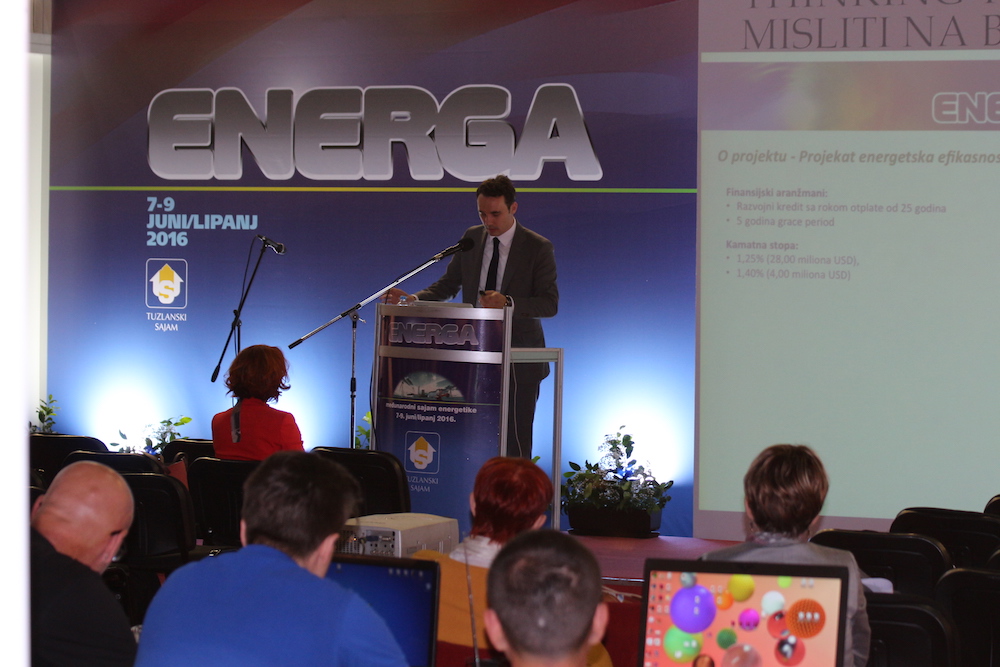
ENERGA Fair is a meeting of prominent domestic and foreign companies and institutions that it’s various research and production achievements, trends and achievements of modern energy, and various forms of business cooperation, presenting to the professional-relevant public.


The exception was neither BEEP project (Bosnia Energy Efficiency Project), where on the second day of the fairs presented their plans for 2016 and 2017. As one of the largest projects in Bosnia and Herzegovina, where only in the FBiH plans to invest 19.20 million in the period of 3 years, it was very interesting to hear the presentation Mustafa Čopelj, Head of the World Bank project for the Federation of Bosnia and Herzegovina.


“Together with our partners we plan to implement energy efficiency measures at 50 facilities in the next two years. We are taliking about public institution, the focus is on learning and health care facilities. Implementation of energy efficiency measures has clear calculations of savings and return on investment through the next period. I sincerely hope that we will be a driver or perhaps the implementer of such projects and for residential buildings, and through a parallel education of citizens to raise awareness about this very important topic”, concluded Čopelj.

BEEP project in a visit to the Energy Community

BEEP project representatives in a visit to the Energy Community

albtmb2043


On 31.05. and 01.06. Representatives of the project BEEP (Bosnia Energy Efficiency Project) for the Federation BiH took part in the activities of coordination group of the Energy Community Secretariat for energy efficiency in Vienna.


During the meeting, the Energy Community Secretariat published a special edition of the legal framework of the Energy Community that focuses solely on energy efficiency. The publication brings together the legal acts in force, the relevant decisions of the Ministerial Council and procedural acts amending the original EU acquis, as well as all implementing directives and delegated regulations on the labeling of energy efficiency which is currently implemented by the Energy Community.


The meeting gathered more than 60 experts together with the Energy Community Secretariat, the European Commission and the donor community. Representatives of the project BEEP were Mr. Mustafa Čopelj, Head of the World Bank project for the Federation of BiH and Adnan Efendić, President of the Project Steering Committee.


Experts also discussed the progress of the development of national action plans for energy efficiency (NEEAPs), and reported about the energy efficiency projects that implement good practices of Energy Community. In particular, they shared their experience in regard to energy services (ESCO) model. In addition, the performance, of the Regional Energy Efficiency Program (REEP) for the Western Balkans in the first two years of implementation, was assessed.


The series of energy efficiency events continued with workshops on the implementation of energy efficiency, directives and funding opportunities and the workshop itself was organized in cooperation with the World Bank.


The final conclusion for Bosnia and Herzegovina is that there are certain delays due to, among other things, failure to pass the law on energy efficiency in BiH.


ENERGY COMMUNITY LEGAL FRAMEWORK – click to download document

Within the BEEP Project the actual consumption and savings are being monitored through built-in measuring devices

After the implementation of energy efficiency measures, monitoring and measurement of the mentioned items shall be continued for at least two more years.

ugradena-oprema

One of the objectives of the World Bank’s Project “Energy Efficiency in BiH” (BEEP) for the Federation of Bosnia and Herzegovina is the confirmation or verification of the expected effects of energy efficiency measures which have been selected through the project implementation. This activity will be realized through Technical Monitoring and Evaluation (TME).

As a prerequisite for achieving this objective, each facility on which the energy efficiency measures are being implemented, got built-in measuring equipment for measurement of the value of important parameters for heating, cooling and ventilation of facilities.

There are currently 28 facilities with built-in equipment, which already have provided us information on the state in these facilities before the implementation of the energy efficiency measures. That information is related to:


Delivered amount of thermal energy for heating of facilities, whereby measurements may be at the minute, hourly, daily, monthly or seasonal record level of measurement results.

Measurement of internal and external temperature and humidity in the three characteristic rooms (according to the purpose), by use of equipment that allows minute, hour, daily, monthly or seasonal (annual) reading of measured values.


By such approach the BEEP offered for the first time a complete and comprehensive model for resolving the issue of energy efficiency. Also, by measuring reports (technical monitoring “before” and “after”) will make quality assumptions to confirm, in other words to verify the expected results after the implementation of energy efficiency measures.


Beside verification and validation of the results of the BEEP Project, data measured and processed through TME will support the goals of the Federation of Bosnia and Herzegovina in terms of savings in energy consumption which are provided by the Action Plan for Energy Efficiency of FBiH (EEAPF), and based on the obligations established by the National Energy Efficiency Action Plan of Bosnia and Herzegovina ( NEEAPs).


“There is no other way to accurately confirm estimates, budgets, analyses and achieved effects of implemented energy efficiency measures of selected scenarios than results obtained by the measurement. For this reason the installation of permanent equipment for monitoring of obtained results is a crucial project to demonstrate the feasibility and viability of the projects of energy efficiency”,  Said Mesud Mustedanagić, Technical Expert of the Implementation Unit of the World Bank Project ” Energy Efficiency in BiH ” for the Federation of Bosnia and Herzegovina.


After the implementation of energy efficiency measures, monitoring and measurement of the mentioned items shall be continued for at least two more years in order to get a more objective picture of actual consumption, savings and comfort in facilities.


For the provision of the above-mentioned data, the following equipment has been installed:


Ultrasonic measurer of delivered thermal energy (based on the measurement of the flow of hot water pipelines), battery power for autonomy in the work and independence of supply from the city network, M-Bus modules, integrated in measurers, for storing of measured data as well as sensors for measuring of temperature in starting and return heating system. For the installation it is necessary to predict calorimeter of required diameter of the heating system for each facility.

Data Logger OPUS for “storage” of obtained data, sensors for indoor and outdoor temperature and humidity as well as Y connectors and BUS cables for functional connection of the above mentioned components of the measuring system.

The application program that processes the peripheral data and provides numerical and graphical display of measured values. The results can be read and downloaded on the spot and also it is possible to upgrade the system for remote reading.